
For many parents, the school bus is the part of the day they worry about most. A principal should be able to answer five questions about every bus at any moment: are its papers valid, who is on board, who is looking after the children, where is it now, and what happened on its last trip. This checklist walks through each one.
1. Papers that never lapse
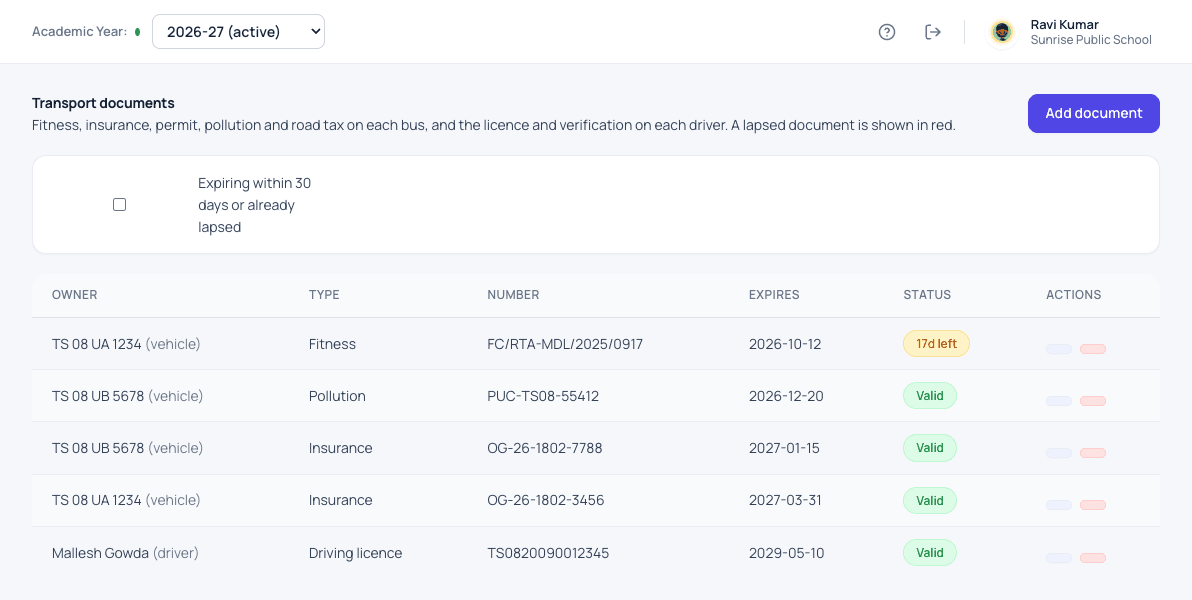
Every school bus carries papers with expiry dates: fitness, insurance, permit, pollution and road tax for the vehicle, and the driving licence and police verification for the driver. Keep the number and expiry date of each one in one place, and review anything expiring in the next 30 days at a fixed time each month. A bus should never run on lapsed insurance because a renewal date was on a sheet nobody opened.
Also follow your state's school bus rules, such as having a trained attendant and a first-aid box on board.
2. A clear list of who rides each bus
The transport office should know, for every route, which children ride it, which stop each child uses and at what time. That list must change the day a child joins, changes stop or leaves the school, not at the end of the term. Watch the number of children against the bus's seating capacity, and act before a bus runs over it.
3. A responsible adult on board
Name a driver and an attendant for every bus. The attendant should tick each child as they board and as they are dropped, so the school knows exactly who was on the bus on any trip. Give parents the driver's and attendant's contact for their child's bus, and nobody else's.
4. Know where the bus is, without calling the driver
Calling a driver who is driving is the least safe way to find a bus. Live bus tracking lets parents and the office see the bus on a map during each trip, with the expected arrival time at each stop and alerts when the bus starts, nears a stop and reaches school. The location should be shared only while a trip is running, and each family should see only their own child's bus.
5. A record of every trip
When a parent asks why the bus was late on Tuesday, the answer should come from a record: when the trip started, when each stop was reached and who boarded. Keep trip records long enough to answer such questions, and no longer than you need them.
6. Protect children's information
- Drivers need children's names and classes, not parents' phone numbers.
- The attendant needs parent phone numbers for their own bus only.
- A parent should never be able to watch another family's bus.
How Patashala360 helps
In Patashala360, routes, stops, buses, crew, bus places, bus fees and vehicle documents are live today, with a transport dashboard that flags full buses and expiring papers. Live bus tracking, with arrival times, boarding records and alerts for parents, is launching soon in the Patashala360 app. See school transport management software, vehicle documents and live bus tracking.
Patashala360 is school management software built for schools in India, with transport in the same software as fees and attendance. Read how to choose the best school management software in India.